| - Lockheed P-38 Lightning Training Film
- now playing in streaming video. Watch the same film used to familliarize P-38 pilots with the Lightning fighter during World War 2.
In 1939, the silvery, sleek new XP-38 prototype set a transcontinental flight record, in a sensational seven hours, two minutes, with only two refueling stops. Originally cast as a long range bomber interceptor, the Lightning was America's fastest and most advanced fighter when it was introduced, but it's early war years were plagued by reliability problems with it's turbocharged Allison engines and inadequate heating that made life miserable for pilots in the Aleutians and high over Germany. These early bugs were worked out by the F & G models and the Lightning served with distinction in a variety of roles throughout the rest of the war. In Europe, the '38s relatively thin 3 bladed props proved ineffective for very high altitude escort duties, her range was less thanthe P-51, and her twin engines made her more costly to produce than the Mustang. So, she was eventually shifted into highly successful fighter/bomber, recon, night fighter, and light bomber roles in the ETO, while continuing as an escort fighter in the MTO.In the Pacific, most air combat was took place at lower altitudes and the 38's twin engines made her a favorite of Army pilots who spent many hours over empty ocean. The '38 became the aircraft of choice of top American Aces in the PTO, including Dick Bong and Tom McGuire. ' 38s handled well, especially for such a large, heavy airplane, had a top speed of over 400 mph, powerful acceleration, and high rates of normal and zoom climb. She could maintain a surprisingly tight turning circle and her conter rotating props and tricycle landing gear made her relatively easy to land & take off for new pilots. The 38's four 50 caliber machine guns and single 20mm cannon, all located in the nose, required no "convergence" sighting and were therefore highly accurate. In later J and L models, the addition of compressibility flaps and hydraulically assisted steering improved her max diving speed and roll rates (respectively ) by an order of magnitude, making an already good ship truly outstanding. About the only significant short coming of the Lightning was spin/.stall recovery, which could be a bear, especially at low altitude. That's is why this film cautions strongly against entering a spin below 10,000', Tom McGuire, intent on surpassing leading ace Dick Bong, lost his life when he attempted to mix up it up at low altitude with a Japanese Ki-43 "Oscar" while still retaining his drop tanks (!) and augured in after an accelerated stall in a tight turn. But all-in-all. the Lightning was an outstandingly versitile and successful aircraft, Perhaps the 38's most memorable mission was the amazing long distance interception and shoot down of Admiral Yamamoto, a strategic turning point in the Pacific War.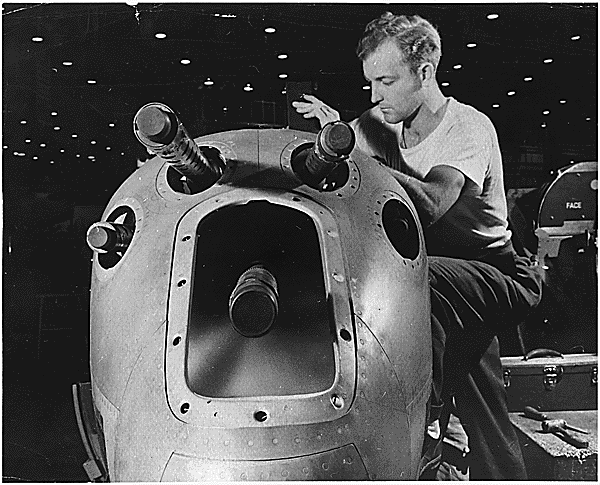 | - The P-38 DVD
- Get "Flight Characteristics of the P-38"
- in full screen digital color plus:
 - * The Back Door Gang: 430th FS Color Scrapbook
- (1945, COLOR 15:00) Exclusive Production
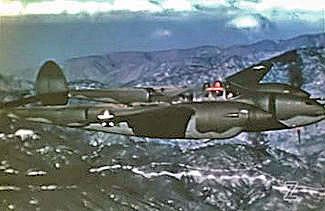
- Drive-In Exclusive Newly discovered film of the 430th FS, 474th FG, 9th Air Force. From the get go, the 474th was configured as a ground attack unit, but they also provided bomber escort and level bombing, led by Norden equipped "Droop Snoops." One of three P-38 squadrons in the 474th, the 430th's call sign was was "Back Door," and its planes and pilots are featured in the film in the Spring of 1945 at their base in Florennes, Belgium. You'll see some intense (and rare) color gun camera film showing strafing attacks inside Germany It's amazing how color film brings 60+ year old images to life.
- * P-38 Reconnaissance Pilot Starring William Holden ("Bridge on the River Kwai") as Lt. "Packy" Cummings. Foto recon pilots Photo Joes) had one of the riskiest, highest impact jobs in the war. Flying camera equipped, unarmed, and often unescorted aircraft -- in this case the Lockheed F-5, a "stripped down" P-38 -- pilots flew deep into enemy territory.
- * Angel in Overalls This film was developed to show US P-38 production line workers the Lightning at work in a wide variety of combat roles. This action packed video is a must see for all P-38 fans
- * Yamamoto shot down! See the P-38 Squadron that shot down Admiral Yamamoto in an incredible long distance interception in the Pacific. Includes gun camera footage of the Admiral's Betty going down in flames.
- * Dick Bong Pacific Ace (1944, B&W, 4:00) This short film pays tribute to Richard "Dick" Bong, the leading American ace of World War II.  Flying P-38s, he had 40 victories in the South Pacific and was renowned for being a remarkably accurate shot.
- * Plus a complete 72 page P-38 pilot's manual including systems charts, diagrams, performance info, plilot's instructions & more!x
- \
- =
 

-- - - | |


 "It's a fighting man's airplane!" (color, 35 minutes)